
Choosing the right framework for mobile application development can make or break your budget, your launch timeline, and your app’s long-term scalability. Flutter, Google’s open-source UI toolkit, has grown into one of the most widely adopted solutions for cross-platform mobile application development, now used by an estimated 46% of software developers worldwide, according to Statista. From Google Pay to BMW’s My BMW app, enterprises are choosing Flutter to cut development costs, unify their engineering teams, and ship faster without compromising on performance. This guide breaks down the top 5 reasons to choose Flutter for your next mobile application development project, backed by 2026 data and real enterprise case studies.
What Is Flutter and Why Does It Matter for Mobile Application Development?
Flutter is Google’s open-source SDK for building natively compiled applications for mobile, web, and desktop from a single codebase written in Dart. It matters for mobile application development because it removes the need to maintain separate iOS and Android teams, code, and release cycles. Instead of translating a design twice, developers write one set of widgets that render identically on both platforms. Flutter compiles directly to native ARM or Intel machine code rather than relying on a JavaScript bridge or WebView, which is why it consistently outperforms hybrid frameworks on animation-heavy and graphics-intensive screens. Google itself uses Flutter in production for Google Pay and Google Ads, a strong signal of the framework’s enterprise readiness.
Reason 1: Single Codebase Cuts Mobile Application Development Costs
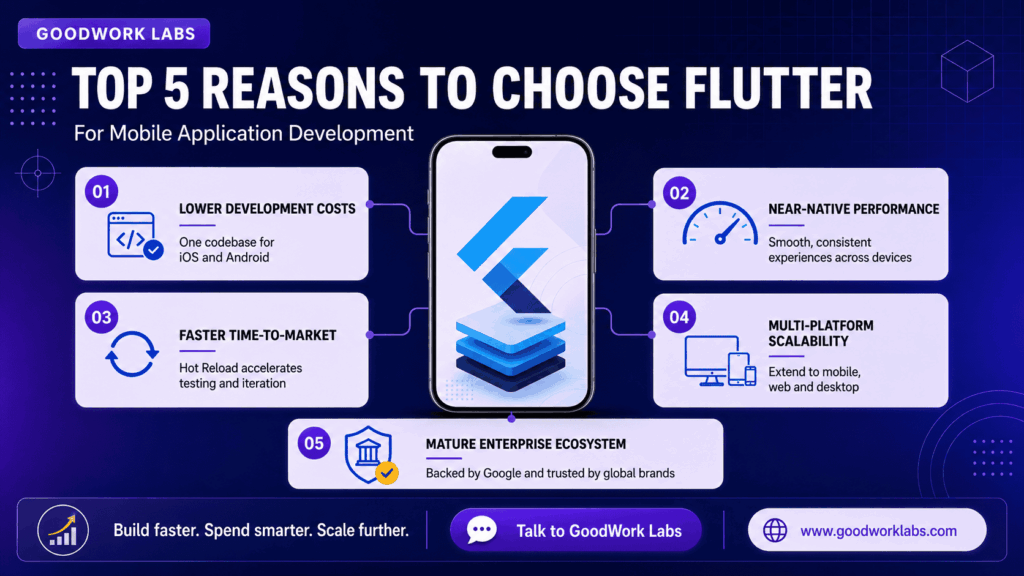
A single Flutter codebase powering both iOS and Android is the single biggest reason enterprises adopt it, and it directly answers the cost question most businesses ask first. Independent research from Deloitte found that companies using Flutter see cost savings of up to 35% on multi-platform builds compared to running separate native teams. Instead of hiring dual Swift and Kotlin teams, a business can staff one Dart-proficient team that ships features to both platforms simultaneously. This is especially valuable for startups and mid-sized enterprises validating a product idea, where every engineering hour spent duplicating logic across platforms is an hour not spent on differentiation. Bug fixes, UI updates, and new features are written once and deployed everywhere, which also lowers long-term maintenance overhead.
Reason 2: Near-Native Performance for a Seamless User Experience
Flutter delivers near-native performance because it compiles directly to native machine code and renders every pixel through its own Skia (and newer Impeller) graphics engine, bypassing OS-native UI components entirely. This means an app’s look and behavior stay consistent at a steady 60fps, or 120fps on supported devices, regardless of whether it’s running on an older Android phone or the latest iPhone. BMW rebuilt its My BMW app entirely in Flutter across 30+ markets specifically to get this consistency across a fragmented device landscape. For businesses building video, animation, or data-visualization-heavy apps, this rendering approach avoids the jank and inconsistency that plague WebView-based hybrid frameworks, translating directly into better app store ratings and lower uninstall rates.
Reason 3: Hot Reload Enables Faster Time-to-Market
Flutter’s Hot Reload feature lets developers see code changes reflected in a running app in under a second, without losing app state, which meaningfully shortens mobile application development timelines. This tight feedback loop means UI tweaks, bug fixes, and A/B test variants can be validated in real time instead of waiting through a full rebuild-and-redeploy cycle that native development often requires. Google reports that this workflow, combined with the single codebase, helped its own Google Pay team scale from a 3-engineer proof of concept to a 150-plus engineer product while cutting feature development effort significantly. For businesses racing to hit a launch date or respond to a competitor’s release, faster iteration cycles translate directly into fewer missed deadlines and lower agency or in-house engineering costs.
Reason 4: One Codebase Scales Across Mobile, Web, and Desktop
Flutter’s scalability extends well beyond phones, letting a single Dart codebase target mobile application development, web, and desktop (Windows, macOS, Linux) from one investment. This matters when a business wants a companion web dashboard, a tablet-optimized layout, or a desktop admin panel without commissioning a separate build for each. BMW uses this same rendering engine across both its customer-facing mobile app and in-vehicle infotainment displays, and the 2026 Toyota RAV4 runs a Flutter-based infotainment experience, illustrating how far the “write once” model now stretches. For a growing business, this means the mobile app you commission today can extend into new form factors later without a ground-up rewrite, protecting the original development investment.
Reason 5: A Mature Ecosystem Backed by Enterprise Trust
Flutter’s ecosystem has matured into one of the most enterprise-trusted frameworks in mobile application development, with roughly 1.5 million monthly active developers building on it worldwide as of 2026. Beyond Google’s own products, financial institutions including Nubank, SoFi, ING Bank Slaski, and Societe Generale run production banking apps on Flutter, choosing it specifically for the compliance-friendly consistency of a shared codebase across regulated platforms. Alibaba, eBay Motors, and ClickUp round out a growing list of consumer and productivity apps built on the framework. Google’s continued investment, most recently Flutter 3.44 and Dart 3.12, along with thousands of published packages on pub.dev, means businesses adopting Flutter today are building on infrastructure with long-term institutional backing rather than a niche or declining toolkit.
Which Businesses Benefit Most From a Mobile App Development Service Built on Flutter?
Startups, fintechs, and mid-market enterprises validating a product across iOS and Android simultaneously benefit most from a mobile app development service built on Flutter. Startups gain a faster path to MVP without doubling their engineering headcount, while fintechs value the pixel-perfect UI consistency regulators and users expect from a banking or payments app. Enterprises managing multiple digital touchpoints, think loyalty apps, internal tools, and customer-facing dashboards, benefit from reusing UI logic across form factors instead of commissioning separate builds. Businesses with tight timelines, limited budgets for maintaining two native teams, or plans to expand into web and desktop down the line are typically the strongest fit for Flutter-based mobile application development.
How GoodWork Labs Delivers Flutter Mobile Application Development Services
GoodWork Labs is a Bangalore-based mobile application development company that has built production Flutter applications for startups and enterprises across fintech, e-commerce, and SaaS. Our engineering team follows an Agile, sprint-based delivery process with continuous integration, so clients see working builds early and often rather than waiting for a single big-bang release.
We handle the full lifecycle, from UI/UX design through Flutter development, QA, and post-launch support, giving businesses a single accountable partner instead of coordinating separate iOS, Android, and design vendors. If you’re evaluating Flutter for your next mobile application development project, our team can assess your requirements and recommend the right architecture for your budget and timeline.
Ready to build your app the smart way?
Talk to our mobile app development team and get a free technical consultation, or explore our UX design studio to see how we approach product design before a single line of code is written.
Conclusion: Is Flutter the Right Call for Your Mobile Application Development?
The five reasons above all point to the same conclusion: Flutter has moved from “promising new framework” to the default, low-risk choice for mobile application development at almost every stage of business, from bootstrapped startups to regulated banks. A single codebase that cuts cost and timelines, rendering that holds up against native apps, Hot Reload that speeds up iteration, and a scalability path into web and desktop, together they solve the four problems that used to force a trade-off between speed, budget, and quality.
And with Google, BMW, Nubank, and hundreds of other enterprises now running Flutter in production, the framework risk that once made teams hesitate has largely disappeared.
What separates a good Flutter app from a great one isn’t the framework, it’s the team behind it. The right partner brings disciplined architecture, real Agile delivery, and design that holds up past the demo. If you’re ready to turn this decision into a working app, get in touch with GoodWork Labs for a free consultation on your Flutter mobile application development project, or contact our team to discuss your timeline and budget.